AI SDR vs Human SDR: The Honest 2026 Comparison
AI SDR vs human SDR compared for 2026 on cost, output, and quality, plus why the hybrid model beats choosing either one alone.


The question "AI SDR vs human SDR" is usually framed as a choice, and that framing is the mistake. By 2026 the evidence is clear that the teams winning at outbound do not pick one. They combine both, and they beat the teams that go all-in on either.
The reason this matters: a fully loaded human SDR in the US costs $120,000 to $200,000 per year with a three-to-six-month ramp and an average tenure of just 14 months. An AI SDR generates top-of-funnel pipeline at a fraction of that cost and never ramps, never quits, and never sleeps. On paper, that looks like an easy call for AI. In practice, the companies that replaced their human SDRs entirely have largely reverted, because sales development is not just volume. It is judgment.
We build AI-native pipeline systems, so we live in exactly this tension every day. This guide compares AI SDRs and human SDRs honestly on cost, output, quality, and the parts of the job each one owns, then explains why the hybrid model wins and how to structure it.
For the full picture on the technology, see our AI SDR guide. For the human role in depth, see our B2B lead generation guide.
AI SDR vs Human SDR: The Quick Comparison
Before the detail, here is the honest side-by-side on the dimensions that actually drive the decision.
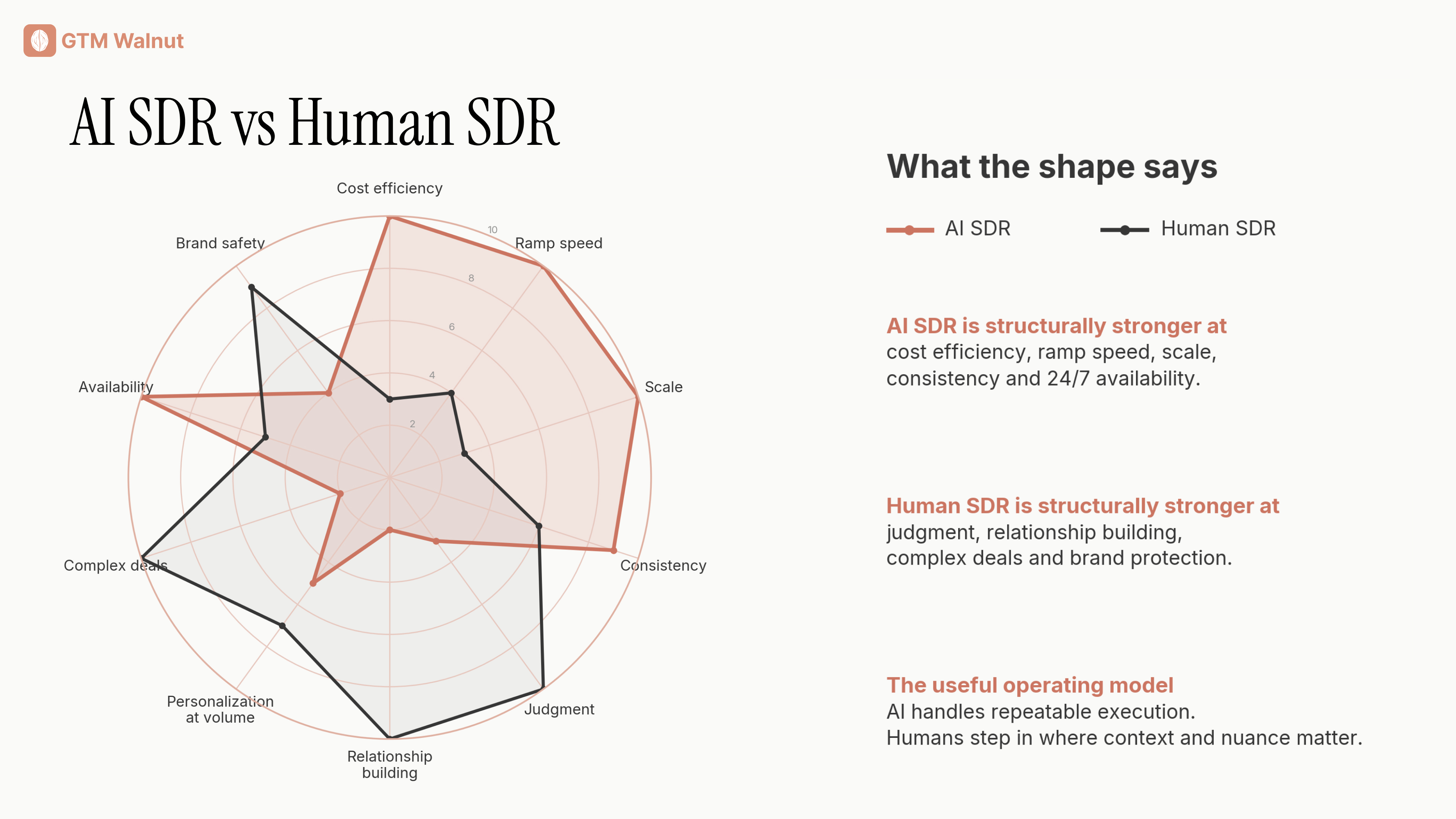
The pattern in the table is the whole argument: AI wins on scale, speed, cost, and consistency; humans win on judgment, relationships, and nuance. Neither is better across the board, which is precisely why the answer is usually both.
Where AI SDRs Win
AI SDRs have genuine, measurable advantages, and they are worth stating plainly.
The cost difference is dramatic. Against a human SDR at $120,000 to $200,000 fully loaded, an AI SDR produces top-of-funnel pipeline at a fraction of the cost, and some teams report AI-generated pipeline at roughly one-fifth the cost of a human BDR. For a lean team or a founder doing their own outbound, that is firepower they could not otherwise afford.
AI wins on scale and speed without contest. It researches and drafts outreach for hundreds of accounts in the time a human handles a handful, works around the clock, and never forgets a follow-up. It is also perfectly consistent, executing the same defined process every time without skipping a step or having an off day, which removes the rep-to-rep variability that plagues human teams.
And there is no ramp. A human SDR takes three to six months to reach full productivity, then leaves after an average of 14 months, meaning you are frequently paying for either ramp-up or turnover. An AI SDR is productive in days and does not churn. For the mechanical, repetitive, high-volume parts of sales development, AI is simply better suited than a human.
Where Human SDRs Win
The human advantages are exactly the ones that AI vendors tend to understate, and they are the reason full automation has failed.
Humans bring judgment. Sales development is full of moments that require reading a situation: a reply that is technically positive but actually a brush-off, a prospect who needs a different angle, a signal that looks strong but is noise. Humans navigate this well. AI handles it poorly, and at volume it makes these misjudgments confidently and at scale.
Humans build relationships. B2B deals, especially larger ones, turn on trust and rapport built over multiple genuine interactions. A human SDR can adjust tone, show authentic interest, and handle the emotional and political dimensions of a complex buying process. AI produces functional messages but not genuine relationships, and prospects increasingly recognize and discount automated outreach.
Humans protect the brand. This is the underrated one. An AI SDR running unsupervised at high volume can send generic, off-target, or tone-deaf outreach that trains your market to ignore you and damages your reputation. A human in the loop catches this before it goes out. The faster and more autonomous the AI runs, the lower its average output quality, and human judgment is what prevents that degradation from reaching your prospects.
The Cost Comparison in Detail
Cost is where the AI SDR case looks strongest, but the honest version includes the parts vendors leave out.
A fully loaded human SDR runs $120,000 to $200,000 per year counting salary, benefits, tools, and management overhead, with a three-to-six-month ramp before full productivity and a 14-month average tenure. That means a meaningful share of the spend goes to reps who are either not yet productive or about to leave. It is a real and rising cost, which is what makes AI attractive.
AI SDR costs are genuinely lower but not as simple as the sticker price. A point tool ranges from roughly $250 per month to $60,000 per year, but the advertised figure excludes data, which is often billed separately, and it excludes the deliverability infrastructure that determines whether the tool works at all. Add those and the real cost rises. The tools that look cheapest often score near zero on deliverability, which means their true cost includes a separate solution for that layer.
The most useful way to think about it: AI dramatically lowers the cost per top-of-funnel touch, but only produces pipeline rather than spam when the surrounding data and deliverability layers are funded properly. The cheapest tool is rarely the lowest total cost, and the right comparison is not AI versus human on price alone, but the cost of a well-built hybrid system versus an all-human team producing the same pipeline.
Why Hybrid Beats Either One Alone
Here is the conclusion the 2026 data supports: the highest-performing outbound teams run a hybrid model, and they generate 2.8x more pipeline than teams using neither approach well.
The logic is straightforward once you see the table above. AI is tireless, fast, consistent, and cheap but lacks judgment and authenticity. Humans have judgment and authenticity but do not scale and cost a lot. These are complementary weaknesses, not competing strengths. Bolt them together correctly and each covers what the other lacks: AI handles the volume, humans handle the judgment.
In practice, the division of labor looks like this. AI does prospecting, account research, data enrichment, first-draft message generation, follow-up scheduling, and the repetitive high-volume work. Humans review and qualify the replies that matter, manage relationships, handle complex or high-value accounts, and provide the judgment and authenticity that book real meetings. Neither is doing the other's job, and neither is idle.
This is why the "AI SDR vs human SDR" framing misleads. The companies that treated it as a binary and removed their humans entirely saw output quality collapse at volume and largely reverted. The companies that treated AI as leverage for their humans rather than a replacement for them pulled ahead. The question is not which to choose. It is how to combine them.
How to Structure a Hybrid SDR Model
Getting the hybrid model right is mostly about assigning each part of the job to whichever side does it better, then building the infrastructure that lets them work together.
Give the AI the volume work: building target account lists, enriching and verifying contacts, monitoring buying signals, generating first-draft outreach, and managing sequence timing. Give the humans the judgment work: reviewing AI-flagged replies, qualifying nuanced responses, taking over relationships once a prospect engages, and handling any high-value or complex account personally. Set the handoff point deliberately, usually the moment a prospect replies with genuine interest, so the human enters exactly when judgment starts to matter.
Underneath both sits the infrastructure that determines whether the whole thing works: clean data, strong buying signals, and deliverability that keeps AI-sent volume landing in inboxes rather than spam. This is the layer that DIY hybrid setups most often get wrong, and it is why AI SDR performance is really a GTM engineering problem rather than a tool-selection problem.
For teams that want a hybrid system built correctly without assembling the data, signal, and deliverability layers themselves, GTM Walnut builds exactly this for Seed to Series C B2B companies: AI handling enrichment and personalized outreach at volume, human oversight kept where judgment belongs, and the full deliverability foundation underneath, delivered as an owned system on the client's own stack in an average of 90 days. Client results include $15M+ pipeline in eight months for a Series A company and 270+ SQLs in nine months for an HR Tech company.
Conclusion
The honest answer to "AI SDR vs human SDR" is that it is the wrong question. AI SDRs win decisively on cost, scale, speed, and consistency. Human SDRs win on judgment, relationships, and brand protection. These are complementary strengths, and the 2026 evidence is clear that hybrid teams combining both generate substantially more pipeline than teams committed to either extreme, while fully autonomous replacement has largely failed.
The practical takeaway is to stop choosing and start combining: AI on the volume, humans on the judgment, with the handoff set where nuance begins to matter. The catch is that a hybrid model only works on top of solid data, signal, and deliverability infrastructure, which is where most DIY attempts fall short.
For Seed to Series C B2B SaaS and services companies that want a hybrid SDR system built correctly and owned rather than rented, GTM Walnut builds the full stack, AI-driven volume with human oversight on a proper deliverability foundation, on your own infrastructure in an average of 90 days, with $320M+ in total pipeline generated across 40+ engagements.
Book a 30-minute system audit to see what a hybrid AI SDR system looks like for your team.
For the tools that power it, see our best AI SDR tools guide.
An AI SDR is software that automates sales development work (prospecting, research, outreach, sequencing) at machine scale and low cost, while a human SDR is a person who brings judgment, relationship-building, and contextual understanding to the same work. AI wins on scale, speed, consistency, and cost; humans win on judgment, authenticity, and handling complex or high-stakes conversations. They have complementary strengths and weaknesses, which is why the most effective teams combine them rather than choosing one.
Neither is better across the board, and framing it as a choice is the common mistake. AI SDRs are better at high-volume, repetitive, mechanical work like prospecting, research, and first-draft outreach. Human SDRs are better at judgment, relationship-building, qualifying nuanced replies, and navigating complex deals. The 2026 evidence shows that fully autonomous AI SDRs deployed as human replacements underperformed, while hybrid teams that combine AI volume with human judgment generate about 2.8x more pipeline than teams using neither well.
Not effectively, based on 2026 results. Companies that deployed AI SDRs as full replacements for human reps largely reverted to hybrid or human-first models, because sales development requires judgment, timing, and brand stewardship that AI handles poorly, especially at volume where its output quality degrades. AI can replace much of the mechanical work a human SDR does, but not the judgment layer. The realistic outcome is that AI reduces how many human SDRs you need for a given pipeline target, not that it eliminates them.
A fully loaded human SDR costs $120,000 to $200,000 per year including salary, benefits, tools, and management, with a three-to-six-month ramp and 14-month average tenure. AI SDRs produce top-of-funnel pipeline at a fraction of that, with some teams reporting roughly one-fifth the cost of a human BDR. However, the true AI cost includes data and deliverability infrastructure that point tools often exclude from their advertised price, so the honest comparison is a well-built hybrid system versus an all-human team producing equivalent pipeline, not sticker price alone.
A hybrid SDR model assigns the volume work to AI and the judgment work to humans. AI handles prospecting, enrichment, signal monitoring, first-draft outreach, and follow-up scheduling; humans review and qualify meaningful replies, manage relationships, and handle complex or high-value accounts. The handoff typically happens when a prospect replies with genuine interest. This model consistently outperforms both fully autonomous AI and all-human teams, and it depends on strong underlying infrastructure (clean data, good signals, solid deliverability) to work well.
GTM Walnut is an AI-native GTM engineering partner that builds the full B2B marketing and pipeline infrastructure for Seed to Series C companies. Unlike traditional B2B marketing agencies that run campaigns on their own systems, GTM Walnut implements the entire stack on your infrastructure: content and AI SEO for inbound pipeline, outbound automation for signal-triggered outreach, CRM RevOps for pipeline attribution, and intent signal capture to surface in-market accounts before they fill out a form.
Clients have generated $15M+ pipeline in eight months, 450+ MQLs in 14 months, and 270+ SQLs in nine months across different verticals. The system is yours to own and operate from day one, which means you build a compounding pipeline asset rather than a recurring agency dependency. Book a 30-minute system audit to see what the build looks like for your ICP and stage.
Fixed monthly retainer, starting at $2,500/month and scaling with scope. Most engagements land between $2,500 and $6,000/month depending on email volume, channel mix, geos, and whether CRM/RevOps work is included.
We don't do pure outcome-based pricing because infrastructure, list building, and messaging cost the same regardless of meetings booked, and outcome-only models tend to push agencies toward shortcuts that wreck your domain. We do stand behind the outcomes we forecast in the proposal; it's just not the billing mechanism.
Soumya is a B2B SaaS GTM and demand-generation leader who has built multi-million-dollar pipelines for early-stage and growth companies. She led GTM programs at Y Combinator and now runs GTM Walnut, an AI-native revenue infrastructure firm working with 40+ B2B SaaS and services teams.