Cold Email: The Complete 2026 Guide
The complete 2026 cold email guide covering deliverability, signal-based personalization, benchmarks, compliance, and the system that books meetings.

Cold email works in 2026, but almost none of the advice written about it does. The tactics that filled inboxes with "quick question" templates and first-name-merge personalization have collapsed. Reply rates on cosmetically personalized emails have fallen under 1%, and the mailbox providers that used to quietly filter bad senders now reject them outright.
Here is the single most important thing to understand: cold email in 2026 is a system, not a tactic. Infrastructure, data, copy, deliverability, and targeting all have to work together, and a weakness in any one of them sinks the whole program. The average cold email reply rate across the industry sits at 3.43%, but signal-based, well-targeted campaigns on clean infrastructure book meetings at 5 to 10x the rate of generic blasts. The gap between those two worlds is what this guide is about.
We build outbound systems for B2B companies, so this comes from running the channel, not theorizing about it. Below we cover what cold email is, whether it is legal, the deliverability infrastructure that keeps you out of spam, how to write emails that get replies in 2026, the sequence and cadence that work, realistic benchmarks, and how to scale without burning your domain.
For related depth, see our cold email deliverability guide and our B2B lead generation guide.
What Is Cold Email?
Cold email is a one-to-one message sent to an individual prospect who has not opted in, with the goal of starting a business conversation. That definition matters because it separates cold email from two things it is often confused with: email marketing and spam.
Email marketing goes to a subscribed list, usually at scale, to nurture people who have already raised their hand. Cold email goes to individuals who fit your ICP but have never engaged, with the goal of starting a genuine one-to-one conversation. The distinction is not just legal; it shapes everything about how the two are written, sent, and measured.
Cold email is also not spam, though the line has tightened. Spam is sent in bulk to anyone with an email address, with no personalization, no research, and no relevance, focused entirely on what the sender wants. Legitimate cold email is targeted, relevant to the recipient's role, and personalized to a real reason for reaching out. In 2026, the organizations that maintain email blocklists have formally taken the position that most generic cold outreach is spam, which means the burden is on the sender to be genuinely relevant. The channel still works, but only when it earns its place in the inbox.
Is Cold Email Legal?
Yes. Cold email is legal in the US and most markets when it complies with the relevant regulations, primarily CAN-SPAM in the US and GDPR in Europe. Cold email is not illegal, and complying is not complicated.
The core CAN-SPAM requirements are straightforward: include a clear way to opt out and honor opt-out requests promptly, provide accurate sender information in your "From," "Reply-To," and routing details, use a subject line that accurately reflects the message, and avoid deceptive or false information. In Europe and under newer US state laws like the Florida Digital Bill of Rights, the emphasis shifts toward consent, documented data sources, and clean suppression lists.
The practical compliance checklist for 2026 is short. Maintain clean opt-out and suppression lists and remove people the moment they ask. Use business email addresses rather than personal ones, and keep records of where you sourced each contact and your legal basis for reaching out. A friendly plain-text opt-out line at the bottom of each email ("Not the right person? Just reply and I'll remove you") satisfies CAN-SPAM, feels more human than a formal unsubscribe link, and actually lifts reply rates because it signals respect. Follow these rules and cold email is a fully legal, effective channel.
Cold Email Deliverability: The Foundation
Deliverability is the layer that determines whether your email reaches the inbox at all, and in 2026 it is the single highest-leverage part of a cold email program. The reason is blunt: open rate is a property of your deliverability, not your copy. A brilliant email that lands in spam produces nothing.
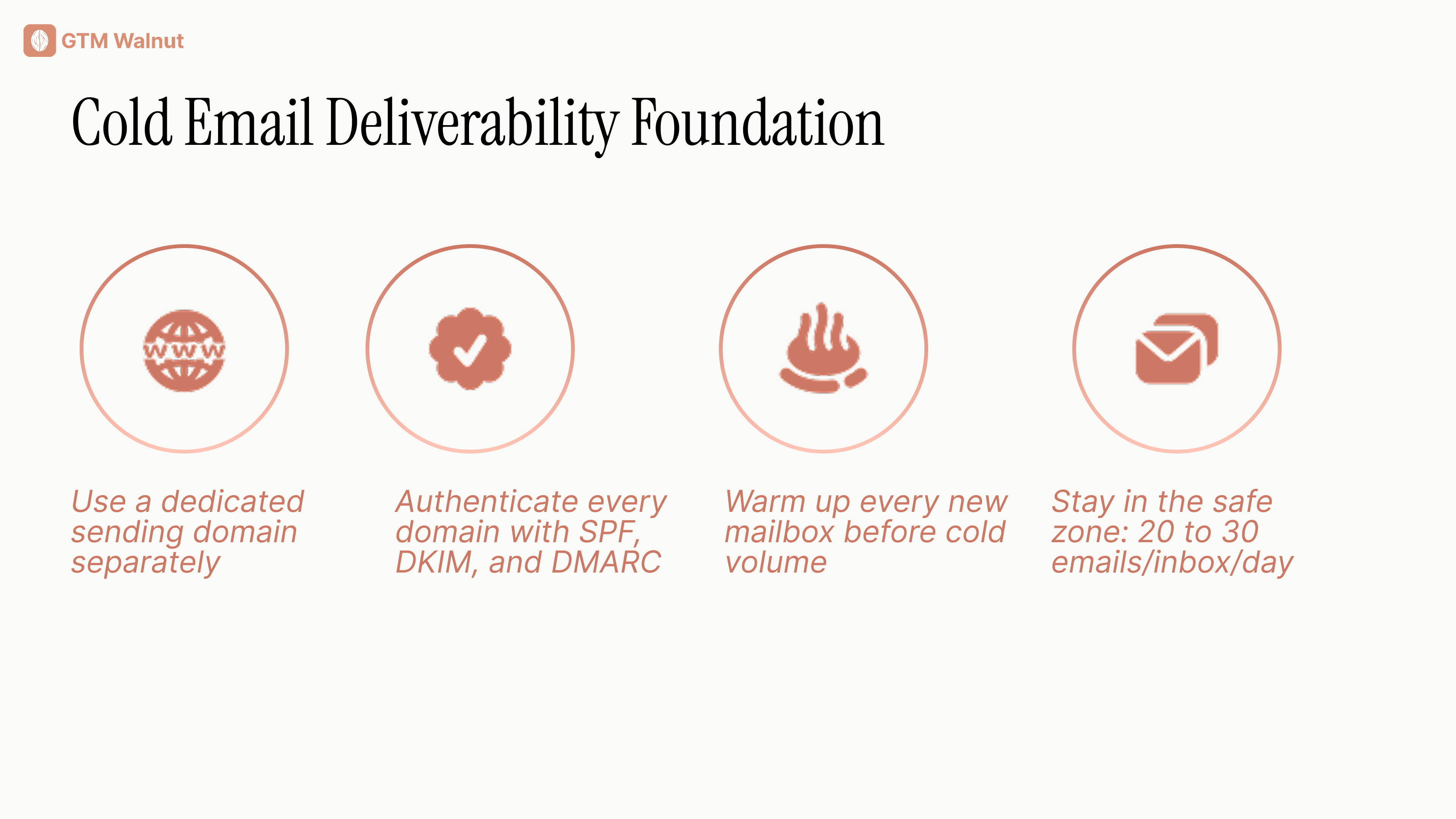
The infrastructure basics are non-negotiable. Use a dedicated sending domain separate from your primary business domain (something like outreach.yourcompany.com), so that if the sending domain takes a reputation hit, your main email is protected. Authenticate every domain with SPF, DKIM, and DMARC, which mailbox providers now enforce rather than merely prefer. Warm up every new mailbox before sending cold volume, gradually ramping from 10 to 25 emails per day in the first two weeks up to full volume over five to six weeks, using a warm-up tool like Instantly or Smartlead that connects your mailbox to a network of real accounts.
Volume discipline is what keeps the whole thing alive. The safe sending limit in 2026 is 50 to 100 emails per mailbox per day; going above that, especially without proper warming, triggers rate limiting and spam classification. To scale beyond that, rotate across multiple warmed mailboxes (three to five per SDR), which puts total daily volume of 200 to 375 emails per SDR in the sweet spot. Keep bounce rate under 3% and spam complaints under 0.3%, the threshold at which Gmail enforcement kicks in, roughly three complaints per 1,000 emails. These two metrics move before your inbox placement collapses, so watch them closely. We go deeper on all of this in our cold email deliverability guide.
How to Write Cold Emails That Get Replies in 2026
The copy rules changed more than anything else in cold email, and the biggest shift is that cosmetic personalization is dead.
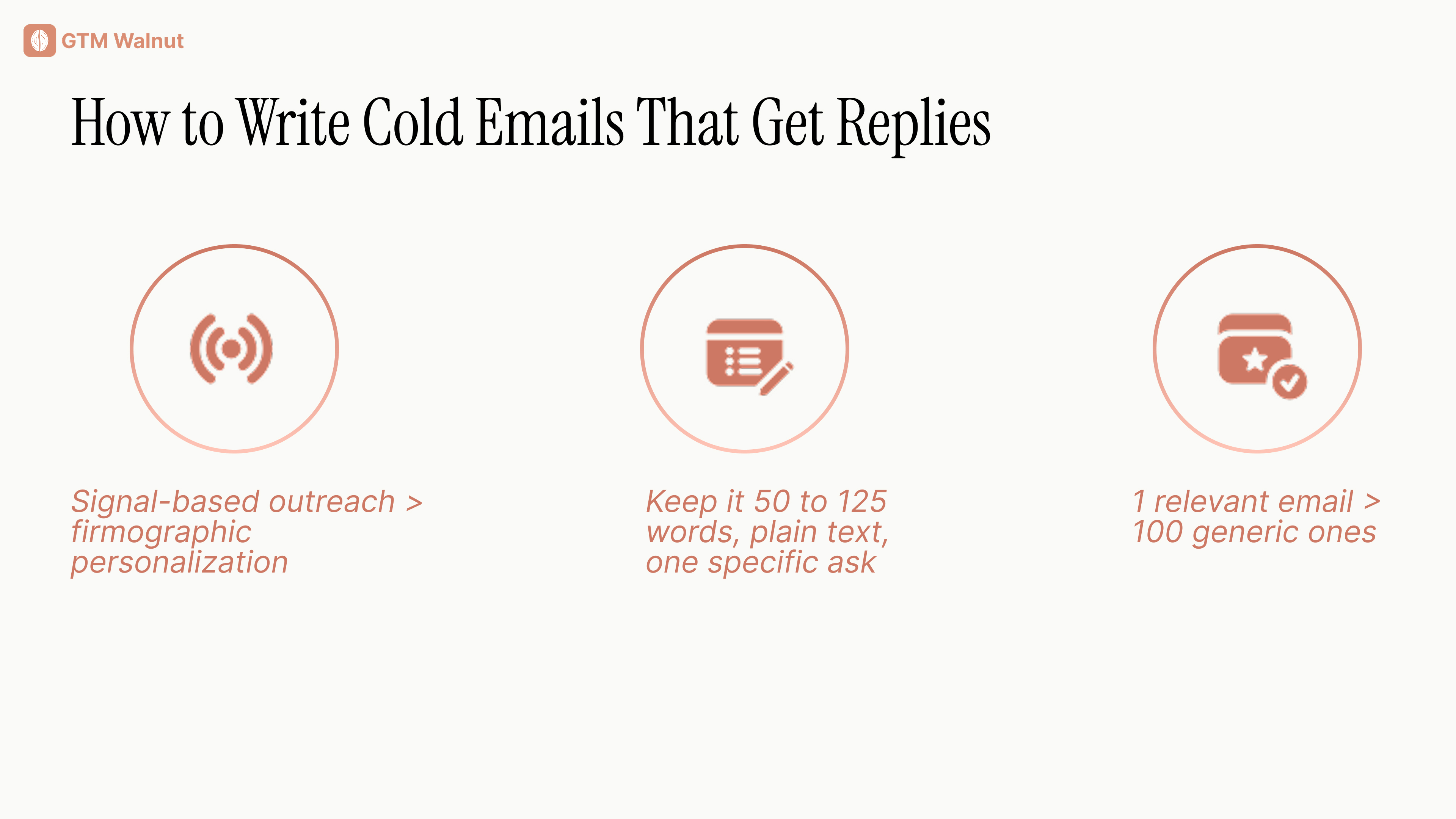
Inserting a first name and company name into a generic template is no longer personalization. It is the new spam, and reply rates on it have collapsed to under 1%. What works now is signal-based outreach tied to a specific, real-world trigger: a funding round, a new executive hire, a product launch, a public post, or a job opening that reveals the prospect's stack or pain. Signal-based personalization outperforms firmographic personalization (company size, industry) by three to five times in reply rates, because it proves you are reaching out for a real reason rather than because their company matched a filter.
The mechanics of the email itself are simple and consistent across the best 2026 data. Keep the initial email between 75 and 125 words; brevity respects the reader's time and lifts replies. Use plain-text formatting rather than heavy HTML, which feels more personal and avoids triggering spam filters. Lead with the prospect and the trigger, not your company. Make a single, specific ask. And write a subject line that accurately reflects the message rather than baiting the open.
The mindset that produces results is precision over volume. The difference between average and top performers comes down to targeting quality and relevance, not how many emails you send. One genuinely relevant email to the right person beats a hundred generic ones, and it protects your domain while it does so.
The Cold Email Sequence and Cadence
A single cold email rarely books a meeting. The follow-up sequence is where most of the pipeline actually comes from.
The data is consistent here: four to seven emails is the sweet spot for a cold sequence, with the 2026 benchmark reports converging on that range. Fewer than four gives up before follow-ups have a chance to work, and 42% of all replies come from steps after the first email. More than nine and the marginal benefit disappears while spam risk rises. A five-touch sequence spread across roughly 14 days has become the standard high-performing cadence.
The bigger cadence shift in 2026 is that email-only outbound underperforms. Single-channel email campaigns cap around 2 to 3% reply rates and underperform multichannel sequences by 40%. Pairing cold email with LinkedIn touches, and where appropriate a call, lifts reply rates by two to three times, because the prospect sees you in more than one place and the outreach reads as intentional rather than automated.
There is also a timing dimension worth understanding. Traditional cold email sends to a static list on a fixed schedule regardless of what the prospect is doing. Signal-triggered outbound, sometimes called warm outbound, launches the sequence when a prospect shows buying intent, such as a pricing page visit, a relevant new hire, or a funding event. Triggering on live intent rather than a fixed calendar is one of the highest-leverage upgrades available to a cold email program, and it is core to how modern GTM engineering systems work.
Cold Email Benchmarks for 2026
Knowing the real numbers lets you diagnose whether a program has a targeting problem, a copy problem, or a deliverability problem. Here are the honest 2026 benchmarks.
Reply rate is the metric that matters most because it cannot be faked or inflated by email clients. The industry average sits at 3.43%, with 5 to 8% being solid and 8 to 15% strong for a well-targeted, personalized campaign on a clean list. Anything above 15% is excellent and usually reflects tight signal-based targeting. If your reply rate is under 2%, the problem is targeting or copy, not deliverability.
Positive reply rate is the real leading indicator of pipeline, and it deserves to be your headline metric rather than raw replies. A 12% reply rate where 5% are genuinely interested beats a 20% reply rate where most responses are annoyed. Track positive replies as the true measure of program health.
On the deliverability side, keep bounce rate under 3% (best-in-class is under 1.5%), since bounces are the highest-leverage metric on the list and every bounce damages sender reputation. Keep spam complaints under 0.3%. Open rate is worth watching only as a deliverability signal, not a success metric, because it has become unreliable and inflated by security scanners; a raw cold list runs 15 to 25% open rates while a fully deliverability-managed send runs far higher. Meeting-booked rate of 1 to 3% is a healthy target for a well-run program.
How to Scale Cold Email Without Burning Your Domain
Scaling is where most cold email programs self-destruct, because the instinct to send more directly conflicts with the discipline that protects deliverability.
The core principle is to scale volume through more warmed mailboxes and domains, never through more emails per mailbox. Since 50 to 100 emails per mailbox per day is the ceiling, growing from 200 to 2,000 emails a day means provisioning and warming more mailboxes across more sending domains, not pushing each mailbox harder. This mailbox and domain rotation is the entire infrastructure game at scale, and it is why serious outbound operations run dozens of warmed mailboxes.
Data quality has to scale with volume, or it sinks the whole thing. Build lists rather than buying them blind, since scraped and bulk-purchased lists carry spam traps, role addresses, and dead accounts that spike bounces and complaints. Verify every list before every send and keep projected bounce under 2%. Cap contacts per company, one active contact at a small business, two or three at mid-market, since emailing five people at the same small company in one week invites internal comparison and spam reports.
The honest conclusion is that cold email at scale is an infrastructure and data discipline as much as a copywriting one. Programs rarely fail on copy; they fail on consent, data quality, and sending infrastructure. This is exactly why many growth-stage B2B companies choose to have the infrastructure built for them. GTM Walnut builds the full cold email and outbound system for Seed to Series C companies, dedicated domains, mailbox warm-up and rotation, verified data via Clay, signal-triggered sequencing, and deliverability infrastructure, as an owned system on the client's own stack in an average of 90 days. It is the cold-email-as-a-system approach the 2026 landscape demands, built so the deliverability foundation is right from day one rather than learned through a burned domain.
Conclusion
Cold email works in 2026, but only as a system where infrastructure, data, copy, deliverability, and targeting reinforce each other. We covered what cold email is and how it differs from spam, the compliance rules that keep it legal, the deliverability foundation that determines whether it reaches the inbox, the signal-based copy and multichannel cadence that get replies now, the real benchmarks for diagnosing problems, and how to scale through mailbox rotation without burning your domain.
The recurring theme is that cold email rarely fails on copy. It fails on infrastructure, data quality, and deliverability, the parts that are least glamorous and most decisive. Teams that treat cold email as a system built on a solid foundation pull far ahead of those chasing the next clever template.
For Seed to Series C B2B SaaS and services companies that want that system built correctly and owned rather than assembled through trial and burned domains, GTM Walnut builds the full cold email and outbound engine, dedicated domains, warm-up and rotation, verified data, signal-triggered sequencing, and deliverability infrastructure, on your own stack in an average of 90 days, with $320M+ in total pipeline generated across 40+ engagements.
Book a 30-minute system audit to see what a cold email system looks like for your stage and ICP.
For foundational pipeline context, see our B2B lead generation guide.
Cold email is a one-to-one message sent to an individual prospect who has not opted in, with the goal of starting a business conversation. It differs from email marketing, which goes to a subscribed list to nurture people who already engaged, and from spam, which is sent in bulk with no personalization or relevance. Legitimate cold email is targeted, relevant to the recipient's role, and tied to a real reason for reaching out. In 2026 it remains one of the most direct channels into a B2B buying committee when done as a system rather than a blast.
Yes, cold email is legal in the US and most markets when it complies with regulations like CAN-SPAM and GDPR. The core requirements are including a clear opt-out and honoring it promptly, using accurate sender information, writing subject lines that reflect the message, using business email addresses, and keeping records of your data sources and legal basis for contact. Cold email is not illegal; it simply has to follow these rules, which mostly amount to being honest and respecting opt-outs.
The industry average cold email reply rate in 2026 is about 3.43%. A reply rate of 5 to 8% is solid, 8 to 15% is strong for a well-targeted personalized campaign on a clean list, and above 15% is excellent. If your reply rate is under 2%, the problem is almost always targeting or copy rather than deliverability. More important than raw reply rate is positive reply rate, the share of replies that are genuinely interested, which is the real leading indicator of pipeline and the metric worth treating as your headline number.
Cold emails land in spam primarily because of deliverability infrastructure problems, not copy. The most common causes are missing or misconfigured authentication (SPF, DKIM, DMARC), sending from an unwarmed mailbox, exceeding the safe volume of 50 to 100 emails per mailbox per day, high bounce rates from unverified lists, and spam complaints above the 0.3% enforcement threshold. Modern spam filters also weigh recipient behavior heavily, so low engagement and complaints compound the problem. Fixing deliverability is an infrastructure discipline: dedicated domains, warm-up, verified data, and volume control.
2-3 emails is the sweet spot for a cold email sequence in 2026, with 3 touches across roughly 7 days being the standard high-performing cadence. 42% of replies come from steps after the first email, with follow-ups sometimes outperforming the introductory email, depending on the prospect's categorical attributes. Pairing the email sequence with LinkedIn touches and, where appropriate, a call, outperforms email-only sequences by two to three times, so the best sequences are multichannel rather than email alone.
GTM Walnut is an AI-native GTM engineering partner that builds the full B2B marketing and pipeline infrastructure for Seed to Series C companies. Unlike traditional B2B marketing agencies that run campaigns on their own systems, GTM Walnut implements the entire stack on your infrastructure: content and AI SEO for inbound pipeline, outbound automation for signal-triggered outreach, CRM RevOps for pipeline attribution, and intent signal capture to surface in-market accounts before they fill out a form.
Clients have generated $15M+ pipeline in eight months, 450+ MQLs in 14 months, and 270+ SQLs in nine months across different verticals. The system is yours to own and operate from day one, which means you build a compounding pipeline asset rather than a recurring agency dependency. Book a 30-minute system audit to see what the build looks like for your ICP and stage.
Fixed monthly retainer, starting at $2,500/month and scaling with scope. Most engagements land between $2,500 and $6,000/month depending on email volume, channel mix, geos, and whether CRM/RevOps work is included.
We don't do pure outcome-based pricing because infrastructure, list building, and messaging cost the same regardless of meetings booked, and outcome-only models tend to push agencies toward shortcuts that wreck your domain. We do stand behind the outcomes we forecast in the proposal; it's just not the billing mechanism.
Soumya is a B2B SaaS GTM and demand-generation leader who has built multi-million-dollar pipelines for early-stage and growth companies. She led GTM programs at Y Combinator and now runs GTM Walnut, an AI-native revenue infrastructure firm working with 40+ B2B SaaS and services teams.