Outbound Lead Generation: The Complete 2026 Guide
Outbound lead generation in 2026: channels, process, signal-based targeting, cold email benchmarks, and how to build pipeline you own.


Outbound lead generation is the most misunderstood channel in B2B. It gets written off as spam, yet companies that run it well build more predictable pipeline than inbound can deliver alone. The confusion comes from lumping two different things under one name: the generic blast that deserves its reputation, and the signal-based, targeted outbound prospecting motion that quietly drives serious revenue.
This guide covers the version that works: a system built on clean data, real buying signals, protected deliverability and coordinated channels that reliably surfaces qualified leads from the exact accounts you want. At GTM Walnut, we build these systems for B2B companies every week, so everything below comes from running the motion, not theorizing about it.
We cover what it is, how it differs from inbound, the channels and process that work now, signal-based targeting, realistic benchmarks, and how to decide between building in-house or partnering. For broader context, see our outbound sales guide and our B2B lead generation guide.
What Is Outbound Lead Generation?
Outbound lead generation is the process of proactively identifying and contacting prospects who fit your ideal customer profile (ICP) but have not expressed interest, in order to create qualified leads for your sales team. You initiate contact rather than waiting for a buyer to raise their hand.
It differs from outbound sales in emphasis rather than kind. Outbound sales describes the whole motion through to a closed deal; outbound prospecting focuses on the top of that motion, generating and qualifying the leads that feed pipeline. The same channels and infrastructure power both.
The mechanics run through cold email, LinkedIn and calling, usually executed by sales development reps (SDRs) who pick target accounts, verify contacts, reach out with a relevant message, qualify those who engage and hand them to account executives. The defining advantage is control: you choose which accounts you pursue and when. GTM Walnut builds that control into the system itself, so the accounts you target are decided by data and signals rather than by whichever list a rep pulled last.
Outbound vs. Inbound Lead Generation
Outbound and inbound solve different problems, and understanding the trade-off is the key to using each well.
Inbound attracts prospects through content, SEO, webinars and paid search. These leads are warmer, so they convert at higher rates and cost less per lead once the engine runs. The limits are control and time: you cannot choose which companies show up, and SEO-led inbound realistically takes six to twelve months to deliver significant results (CXL).
Outbound lets you choose your targets and reach them in weeks. The trade-off is that prospects start cold, so reply rates are lower, and the channel needs real infrastructure (data, deliverability and sequencing) to work at all.
The strongest pipeline engines run both. Inbound captures demand already in motion; outbound creates demand among the accounts you most want. The highest-converting outbound targets accounts that are also showing inbound signals, such as a pricing-page visit. GTM Walnut wires those inbound signals directly into outbound sequences, so your two channels feed each other instead of running in separate silos.
Outbound Lead Generation Channels
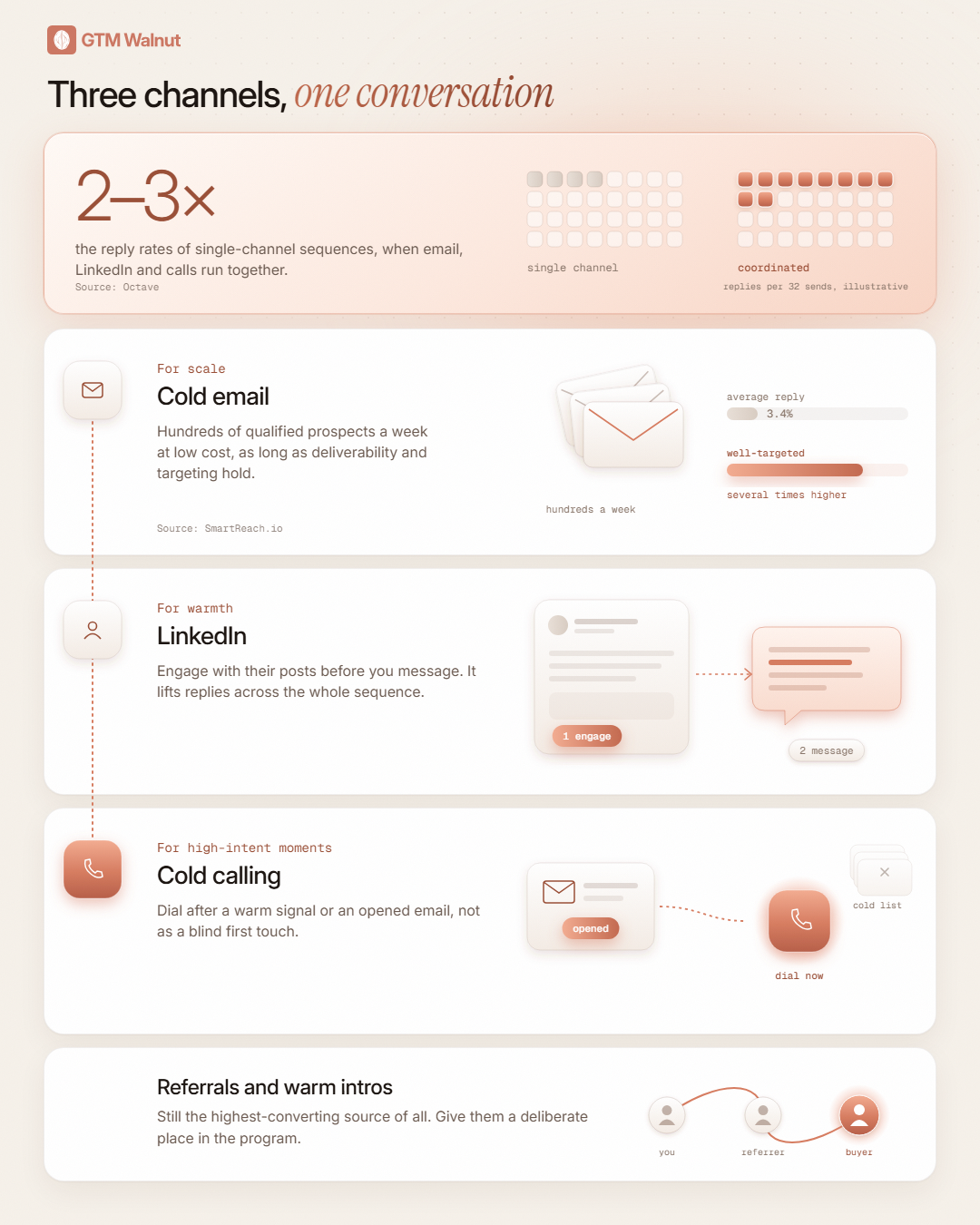
Modern outbound is multichannel by necessity. Data from outbound platforms consistently shows coordinated multichannel sequences earning two to three times the reply rates of single-channel ones (Octave).
Cold Email for Scale
Cold email is the scalable backbone, reaching hundreds of qualified prospects a week at low marginal cost when it runs on sound deliverability and signal-based targeting. Average cold email reply rates now sit around 3.4% (SmartReach.io), but well-targeted campaigns do several times better. GTM Walnut stands up the full sending infrastructure for every client, so email volume never comes at the cost of inbox placement. See our cold email guide.
LinkedIn Outreach for Warmth
LinkedIn works as a warm-up and context layer. Engaging with a prospect's content before messaging lifts replies across the whole sequence, and relevant messages beat cold connection requests. GTM Walnut coordinates LinkedIn touches with email timing so the prospect sees one consistent conversation.
Cold Calling for High-Intent Moments
Calling works best as a follow-up to a warm signal or an opened email, not a blind first touch. Referrals and warm introductions remain the highest-converting source of all and deserve a deliberate place in any program. GTM Walnut triggers calls at those high-intent moments automatically, so reps dial when the odds are best rather than working a cold list.
The Outbound Lead Generation Process
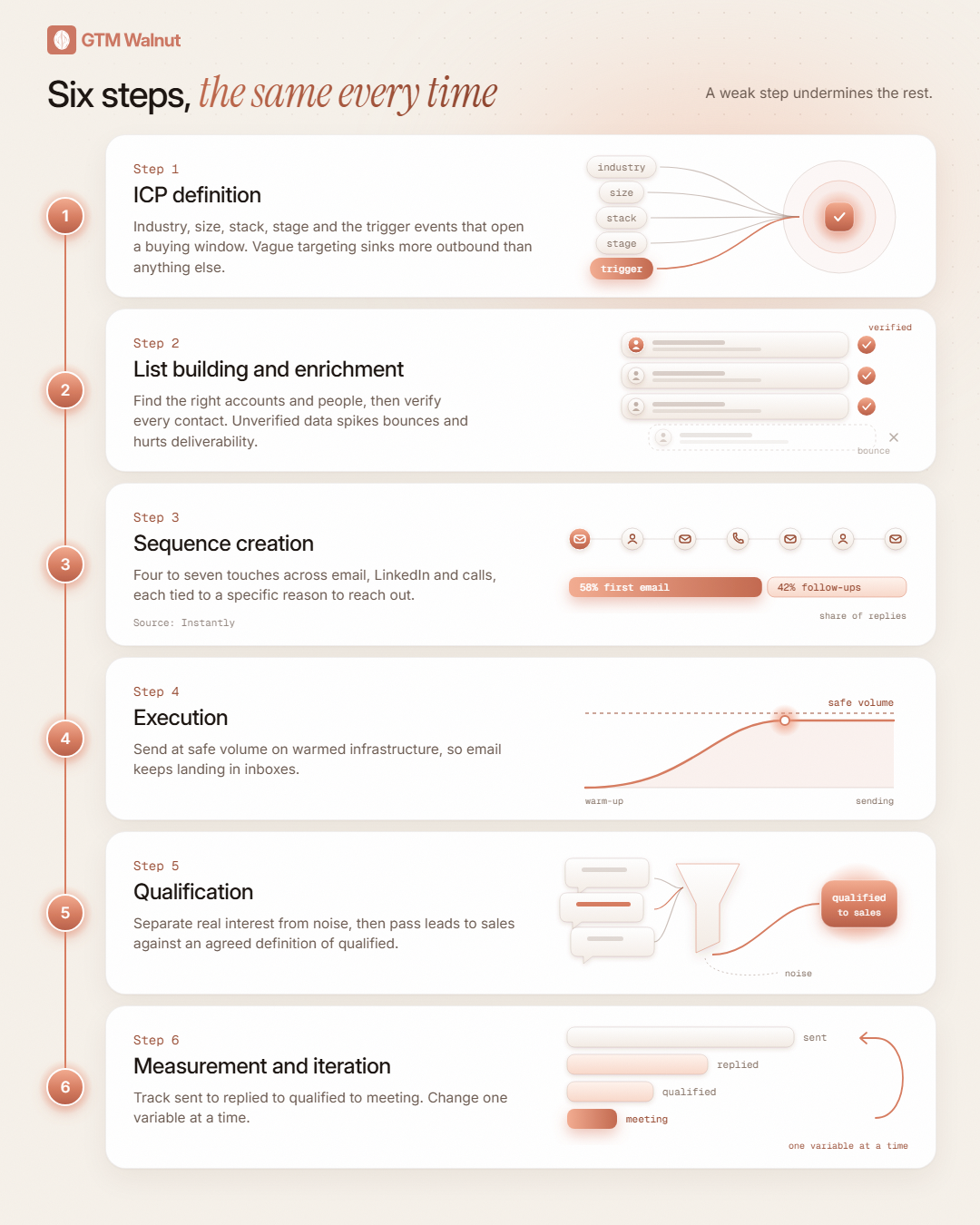
A repeatable outbound prospecting motion runs the same six steps every time, and a weakness at any step undermines the rest.
1. ICP Definition
Specify target companies and roles by industry, size, tech stack, growth stage and the trigger events that open a buying window. Vague targeting is the leading cause of outbound failure.
2. List Building and Enrichment
Identify the right accounts and people, then find and verify contact details. Unverified data spikes bounce rates and damages deliverability.
3. Sequence Creation
Build a multichannel sequence of four to seven touches across email, LinkedIn and calls, each tied to a specific reason for reaching out. Follow-ups matter: the first email captures 58% of replies and follow-ups capture the other 42% (Instantly).
4. Execution
Send at safe volume on warmed infrastructure with the deliverability discipline that keeps email in inboxes.
5. Qualification
Handle replies, separate genuine interest from noise, and pass qualified leads to sales against a clear, agreed definition of "qualified."
6. Measurement and Iteration
Track the funnel from sent to replied to qualified lead to meeting, and treat each sequence as a hypothesis, changing one variable at a time.
GTM Walnut builds all six steps into one connected system with waterfall enrichment and full-funnel tracking, so you can see exactly which step is leaking pipeline instead of guessing. For the tactics behind each step, see our outbound sales strategies guide.
Signal-Based Targeting for Outbound Lead Generation
The biggest advance in outbound lead generation is the shift from static lists to signal-based targeting. It is what separates programs that create qualified leads from those that create spam complaints.
Traditional outbound sends to a fixed list on a fixed schedule. Signal-based targeting triggers outreach when a prospect shows a real buying signal: a funding round, an executive hire, a job posting that reveals their stack, a competitor switch, or a pricing-page visit. You reach out because something genuine happened, not because the company matched a filter.
Relevance now decides whether outreach works at all. Deeply personalized cold emails earn reply rates of up to 18%, roughly double the ~9% that basic templates get (Woodpecker), and a real trigger is the strongest personalization available.
Operationalizing signal-based targeting (monitoring signals, enriching the accounts that fire, and launching sequences while the signal is fresh) is a systems problem at heart, which is the core of GTM engineering. It is also the first thing GTM Walnut builds for every client, wired into your own stack so signals turn into outreach within minutes rather than days.
Outbound Lead Generation Benchmarks
Real numbers tell you whether a program has a targeting, copy or deliverability problem.
Reply and Conversion Benchmarks
Reply rate is the headline health metric because it cannot be faked. The average sits around 3.4%, while the top 10% of senders reach 10.7% or more (Instantly). In our experience, a reply rate under 2% almost always points to targeting or copy rather than deliverability. Positive reply rate (the share of replies that are genuinely interested) is the real leading indicator of qualified-lead volume.
Cost and Deliverability Benchmarks
Outbound agencies typically charge $150 to $400 per meeting (Danish Lead Co.). Keep bounces under 3% as a working rule, and keep your user-reported spam rate below 0.1%, never reaching 0.3% (Google sender guidelines FAQ). These move before inbox placement collapses.
GTM Walnut builds these metrics into a single dashboard for every client, so positive replies and cost per meeting become the scoreboard instead of raw activity.
Building Outbound Prospecting In-House vs. Partnering
Once outbound has proven it can work, most companies face a choice: build internally or bring in a partner.
Building in-house gives you control and institutional knowledge, but it is slow. Time to first qualified meeting for an in-house SDR team runs three to six months, against four to eight weeks for an agency (Glencoco). The surrounding system of enrichment, deliverability, signal monitoring and sequencing is a substantial build in its own right; the infrastructure, not the headcount, decides whether it succeeds.
A traditional agency gets qualified leads faster, but you rent pipeline that stops when payment stops, and the data and infrastructure leave with the agency. That is why many growth-stage B2B companies now choose a GTM engineering partner like GTM Walnut, which builds the system on your own infrastructure and hands it off, combining agency speed with in-house permanence. For how this compares with agency models, see our B2B lead generation services guide.
Why Choose GTM Walnut for Outbound Lead Generation
GTM Walnut builds the complete outbound system for Seed to Series C B2B SaaS and services companies: signal capture, waterfall enrichment, AI-personalized multichannel outreach with human oversight, and the full deliverability foundation, on your own stack in an average of 90 days.
What you get as a customer:
- An engine you own. The infrastructure, data and playbooks stay with you, so pipeline does not stop when an invoice does.
- Speed without shortcuts. A production-ready system in about 90 days, instead of four to six quarters of trial and error.
- Proven results. $15M+ pipeline in eight months for a Series A company, and 270+ SQLs in nine months for an HR Tech company.
- Leverage, not headcount. Our hybrid model puts AI on research and drafting and humans on judgment, so a small team produces large-team output. See our AI SDR guide.
Conclusion
Outbound lead generation works in 2026 as a disciplined, signal-based system rather than a volume game. We covered what it is and how it differs from inbound, the channel mix of cold email, LinkedIn and calling, the six-step process, the shift to signal-based targeting, the benchmarks that reveal what is working, and the build-versus-partner decision.
The common thread is that outbound succeeds or fails on infrastructure and relevance, not effort. The teams pulling ahead treat it as a system: clean data, real signals, protected deliverability and coordinated channels, tuned continuously.
That system is exactly what GTM Walnut builds. For Seed to Series C B2B SaaS and services companies that want it built correctly and owned rather than assembled through trial and error, GTM Walnut delivers the full outbound engine on your own stack in an average of 90 days, with $320M+ in total pipeline generated across 40+ engagements.
Book a 30-minute system audit to see what an outbound lead generation system looks like for your stage and ICP.
Outbound lead generation is proactively identifying and contacting prospects who match your ICP but have not shown interest, to create qualified leads for sales. It runs through cold email, LinkedIn and calling, and its main advantage is control over which accounts you pursue.
Inbound attracts warmer prospects through content and SEO but takes months to ramp and offers little control over who shows up. Outbound prospecting reaches the accounts you choose within weeks but starts colder. The best programs run both and use signal-based targeting to focus outbound on accounts already showing intent.
Define a precise ICP, build and verify a target list, and run a four-to-seven-touch multichannel sequence tied to real buying signals such as funding or a new executive hire. Protect deliverability with dedicated domains, authentication and mailbox warm-up, and measure positive replies and qualified meetings rather than raw activity.
It depends on the model. In-house means SDR salaries plus a tooling stack and a three-to-six-month ramp; agencies typically charge $150 to $400 per meeting. The key question is whether you are renting pipeline or building an owned system, so always compare total cost against qualified pipeline, not activity.
GTM Walnut builds a complete, signal-based outbound system on your own stack in an average of 90 days, covering signal capture, enrichment, multichannel cold email and LinkedIn outreach with human oversight, and deliverability. You own the engine permanently, and clients have generated $15M+ in pipeline in eight months.
GTM Walnut is an AI-native GTM engineering partner that builds the full B2B marketing and pipeline infrastructure for Seed to Series C companies. Unlike traditional B2B marketing agencies that run campaigns on their own systems, GTM Walnut implements the entire stack on your infrastructure: content and AI SEO for inbound pipeline, outbound automation for signal-triggered outreach, CRM RevOps for pipeline attribution, and intent signal capture to surface in-market accounts before they fill out a form.
Clients have generated $15M+ pipeline in eight months, 450+ MQLs in 14 months, and 270+ SQLs in nine months across different verticals. The system is yours to own and operate from day one, which means you build a compounding pipeline asset rather than a recurring agency dependency. Book a 30-minute system audit to see what the build looks like for your ICP and stage.
Fixed monthly retainer, starting at $2,500/month and scaling with scope. Most engagements land between $2,500 and $6,000/month depending on email volume, channel mix, geos, and whether CRM/RevOps work is included.
We don't do pure outcome-based pricing because infrastructure, list building, and messaging cost the same regardless of meetings booked, and outcome-only models tend to push agencies toward shortcuts that wreck your domain. We do stand behind the outcomes we forecast in the proposal; it's just not the billing mechanism.
Soumya is a B2B SaaS GTM and demand-generation leader who has built multi-million-dollar pipelines for early-stage and growth companies. She led GTM programs at Y Combinator and now runs GTM Walnut, an AI-native revenue infrastructure firm working with 40+ B2B SaaS and services teams.